Atomic Bonding
- Covalent bonds and carbon's four sharesnot yet tested
- Ionic bonds and the NaCl latticenot yet tested
- Formulas of water and table saltnot yet tested
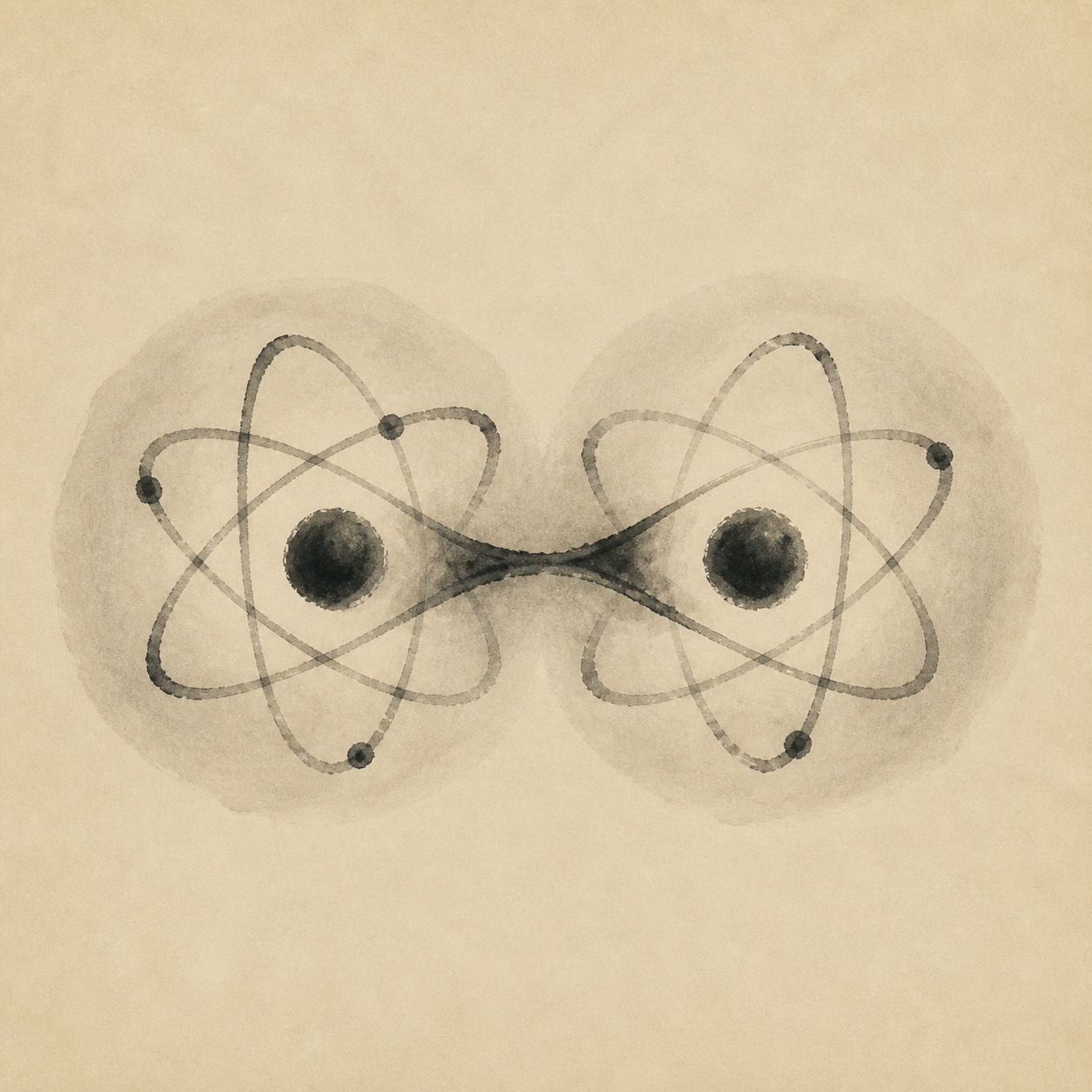
Gilbert N. Lewis, working at Berkeley, published a paper in 1916 titled The Atom and the Molecule. In it he proposed that atoms hold together by sharing pairs of electrons — a covalent bond — and introduced the dot diagrams every chemistry student still draws. Walther Kossel in Germany independently proposed ionic bonding the same year. The chemistry of the electron — the rearrangement of negatively-charged particles between atoms — was the great unification of chemistry, giving the periodic table a mechanistic explanation rather than just an organizing pattern. Linus Pauling's The Nature of the Chemical Bond (1939) extended Lewis's framework with quantum mechanics and with electronegativity, the single number that predicts most of bonding behaviour, and won him the 1954 Nobel for the synthesis.
Atoms bond because the result is energetically favourable — electrons settle into lower-energy configurations than they had in the isolated atoms — and Pauling's electronegativity scale gives the single parameter that predicts most of what happens. Electronegativity runs from fluorine at 4.0 down to francium at 0.7, and the difference between two atoms decides the bond's character. Small differences produce nonpolar covalent bonds, where the atoms share pairs of electrons that sit between the two nuclei and are attracted to both; hydrogen gas, oxygen gas, and organic molecules generally live in this regime. Intermediate differences make the shared pair sit closer to the more-electronegative atom, leaving a partial negative there and a partial positive on the other side, and water's bent geometry and the resulting hydrogen-bond network is the consequential downstream effect. Large differences abandon sharing entirely: one atom transfers an electron, the other accepts it, and the resulting opposite charges produce the crystal lattices of NaCl and MgO. Metallic bonding is the separate limit where valence electrons delocalize into a sea shared across the lattice, which is what makes metals conduct heat and electricity, bend without breaking, and reflect light.
Lewis's dot-pair picture survives more or less intact a century in, even as the underlying quantum mechanics has been worked out in detail. Valence-bond theory describes a bond as overlap of atomic orbitals; molecular-orbital theory describes electrons as occupying orbitals that span the whole molecule. MO theory is more general and accurate, VB more chemically intuitive, and resonance — when no single Lewis structure adequately describes a molecule like benzene or the carboxylate ion — falls out as a superposition of contributing structures. Bond order, the number of shared pairs, sets bond strength and length: triple bonds are shorter and stronger than double, which are shorter and stronger than single, and that single ordering carries an enormous fraction of practical chemistry.