Antibiotic Resistance
- Drugs that kill bacteria, not virusesnot yet tested
- Cell wall and other bacterial-only targetsnot yet tested
- Fleming's 1928 penicillin discoverynot yet tested
- Resistance as natural selection in real timenot yet tested
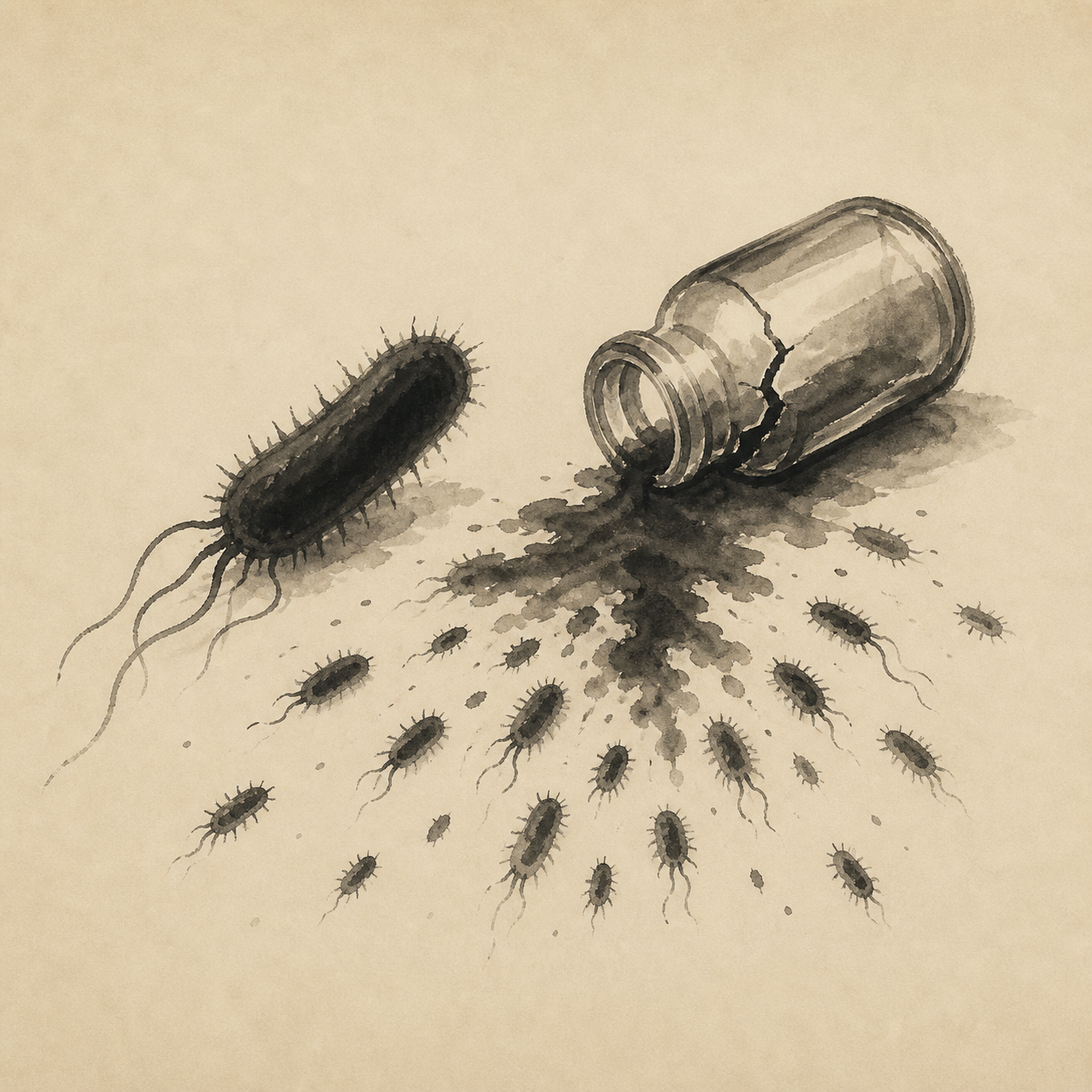
In his 1945 Nobel lecture, Alexander Fleming — who had discovered penicillin seventeen years earlier — paused to warn that the drug's promise carried a trap. Expose microbes to a dose too small to kill them, he said, and you simply teach them to survive it; the careless patient who under-doses himself breeds his own resistant strain. He was exactly right, and faster than almost anyone expected. Penicillin-resistant staph was a clinical reality within a few years of the drug going mainstream, and every new class of antibiotic since has been met, sooner or later, by the same answer from the bacteria. Antibiotic resistance is natural selection running in real time, in a Petri dish or a hospital ward, and it is the slow-motion emergency of modern medicine.
Antibiotics exploit the differences between bacterial cells and our own — penicillin and its relatives wreck the cell wall bacteria need and we lack; others jam the microbial ribosome or block the copying of DNA. Each drug buys a window of clinical usefulness, and each window is closed by the same evolutionary logic. Somewhere in a vast population, a few cells already carry a mutation that inactivates the drug, alters its target, or pumps it back out; the antibiotic kills their neighbors and hands the survivors the world. What turns this local skirmish into a global one is horizontal gene transfer: resistance genes ride on loops of DNA that bacteria swap between individuals, species, even genera, so a defense that evolves in a harmless soil microbe can reach a deadly pathogen in a few years rather than the eons ordinary inheritance would require.
The pressure driving all this is enormous and largely self-inflicted. The world uses antibiotics by the hundreds of thousands of tonnes, much of it poured into livestock at low doses — precisely the conditions that select for resistance without curing anything. Hospitals concentrate sick patients, heavy drug use, and resistant organisms in the same corridors, and farm runoff carries the genes back out into the environment that seeded them. The result was already measured, in the first global estimate for 2019, at more than a million deaths directly attributable to resistant infections — on the scale of malaria. And the deepest problem is economic: antibiotics are taken briefly, then work themselves out of a job as resistance erodes their value, so the returns are poor, and by the 2020s most large drugmakers had walked away from developing new ones. The threat Fleming named is arriving on schedule, and the countermeasures — phage therapies, machine-discovered compounds, bacterial vaccines — are racing a curve that has been bending the wrong way for forty years.