Anthropogenic Climate Change
- CO₂ levels and the Keeling Curvenot yet tested
- Methane and other warming agentsnot yet tested
- Climate versus weathernot yet tested
- The Paris Agreement and 1.5 °Cnot yet tested
Three numbers set the frame. Atmospheric CO₂: 280 ppm in 1750; 420 ppm in 2024; rising at ~2.5 ppm per year. Global mean surface temperature: +1.3°C above the 1850-1900 baseline as the 2020s stand, with the four major instrumental records agreeing within ~0.1°C. Cumulative human CO₂ emissions since 1750: ~2,500 Gt, of which roughly half remains in the atmosphere. The IPCC AR6 statement (2021) is that it is unequivocal that human influence has warmed the atmosphere, ocean, and land. That is the settled core. Everything else — climate sensitivity, the timing of tipping points, regional impact magnitudes, decarbonization pathways, adequate policy response — is genuinely contested. The polymath move is to be clear about which is which.
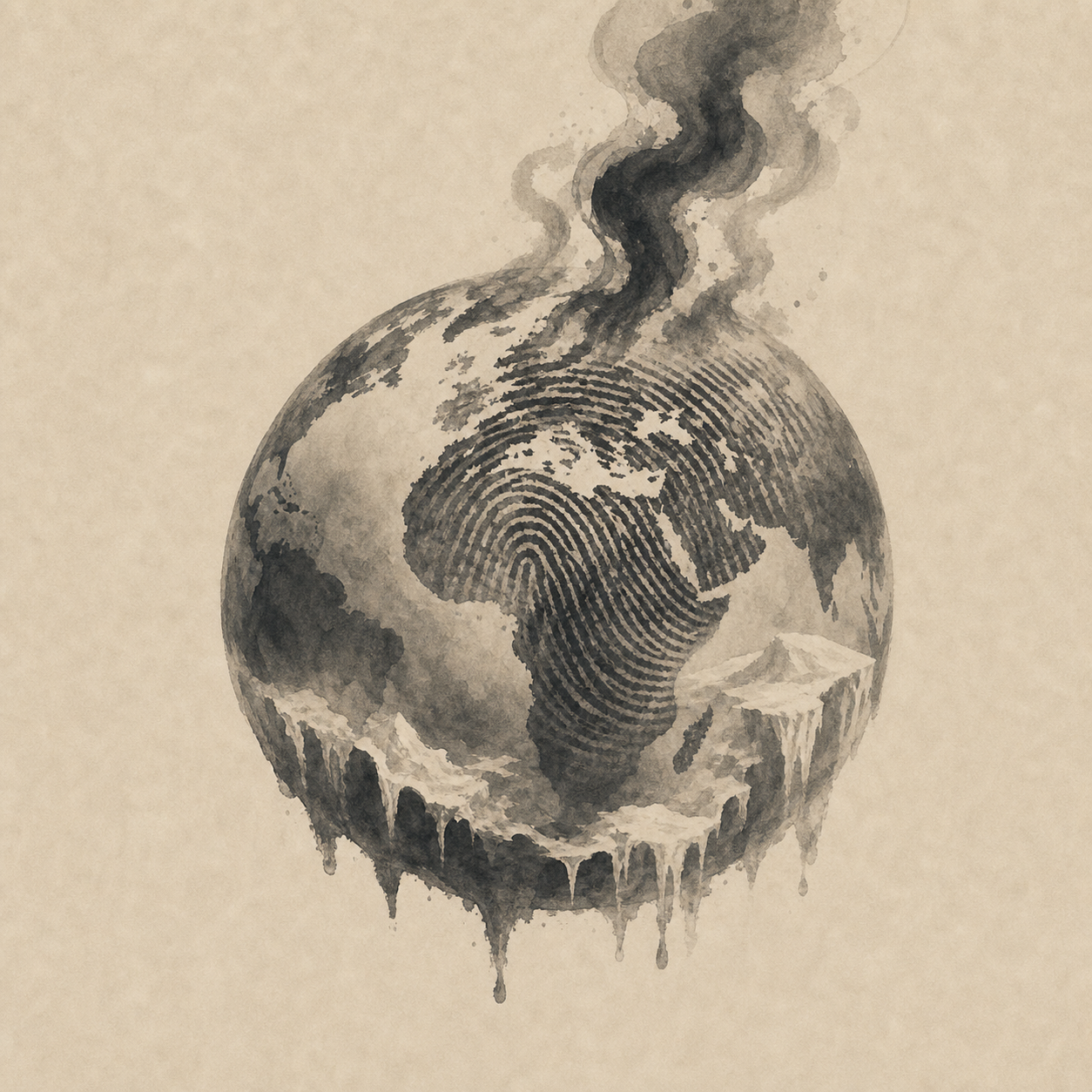
The case for human-caused warming does not rest on any single measurement. It rests on the convergence of independent lines of evidence. Direct CO₂ measurements since 1958 — the Keeling curve — and ice-core records extending back ~800,000 years show that current concentrations exceed anything in the last million years. Surface temperature records from thousands of weather stations and ocean buoys, processed independently by multiple groups, produce consistent global trends. Process-level physics — radiative-transfer codes computing the infrared absorption of CO₂ and methane molecule by molecule from quantum mechanics — predicts the magnitude of warming the observations show. The strongest evidence is in the fingerprints: CO₂-driven warming heats the lower atmosphere and cools the stratosphere; solar-driven warming would warm both. Arctic amplification at three to four times the global rate, greater warming over land than ocean, more warming at night than in the day — all predicted by CO₂ forcing, all observed. The isotopic signature of atmospheric CO₂ fingerprints fossil-fuel origin. The evidence can be organized into four broad levels of confidence and dispute. The settled core — CO₂-driven warming, ocean acidification, sea-level rise, broad direction of regional impacts — is not in serious dispute among working climate scientists. Likely but uncertain in magnitude covers climate sensitivity within the IPCC's 2.5-4°C range, threshold values at which tipping elements may switch state, and decadal-scale regional patterns. Genuinely contested are the feasibility of specific decarbonization pathways and the timing of cascade risks. Politics and values, not science governs how much warming is acceptable. Conflating these levels in either direction is the most common failure mode of public climate discourse.