Angular Momentum
- L = r × p and L = I·ωnot yet tested
- Conserved when no external torque actsnot yet tested
- Gyroscopic precession perpendicular to spin and torquenot yet tested
- Quantized orbital and half-integer spinnot yet tested
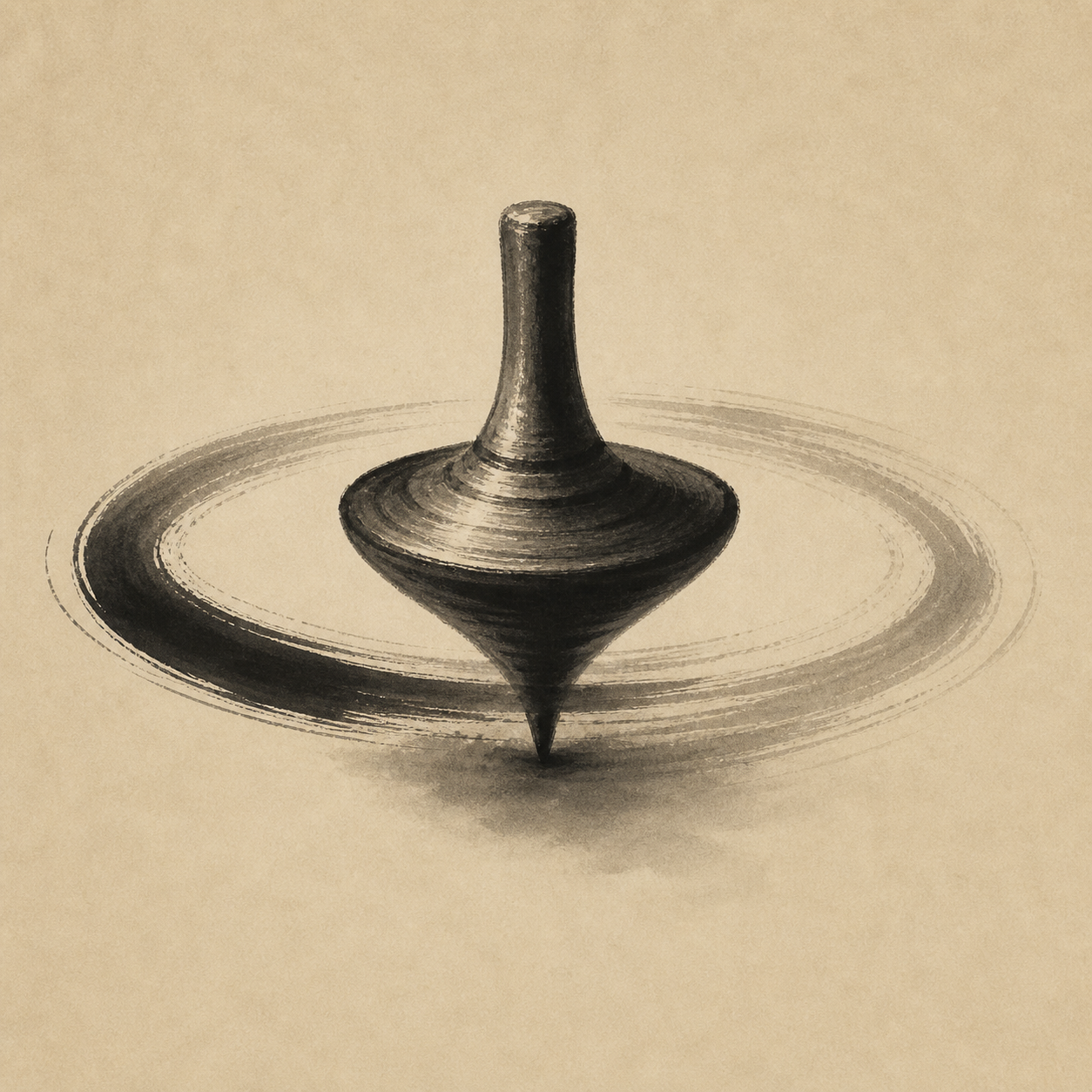
A figure skater pulling her arms in speeds up. A gyroscope mysteriously resists tipping. A neutron star — the collapsed remnant of a massive stellar core — spins hundreds of times per second. The single principle behind all three phenomena is conservation of angular momentum: the rotational analogue of linear momentum, conserved when no external torque acts. The principle is deeply geometric — it follows from the rotational symmetry of the laws of physics — and it operates from the spin of an electron (the smallest persistent angular momentum we know) to the rotation of galaxies.
Angular momentum about a chosen axis is 𝐋 = 𝐫 × 𝐩 — the cross product of position vector (from the axis to the body) and linear momentum. For a rigid body rotating with angular velocity 𝛚, 𝐋 = I·𝛚, where I is the moment of inertia — a tensor characterizing how the body's mass is distributed about the axis. Conservation: in the absence of external torque, 𝐋 is constant. The skater's spin-up: arms in → smaller I → larger ω, conserving L. Torque itself is the rate of change of angular momentum (𝝉 = d𝐋/dt) — the rotational analogue of force. Gyroscopic precession is the geometric phenomenon where applying a torque to a spinning body causes the rotation axis to precess (slowly turn) rather than tip directly: the response is perpendicular to both the spin and the torque, because angular momentum is a pseudo-vector and torque adds vectorially to it. Kepler's second law — that a planet sweeps equal areas in equal times — is conservation of angular momentum about the sun. Quantum mechanics makes angular momentum quantized: orbital angular momentum has eigenvalues ℏ·√(l(l+1)) for l = 0, 1, 2, …, and spin angular momentum has half-integer values for fermions. The spin-statistics theorem (Pauli, 1940) ties angular momentum to particle statistics: half-integer spin → fermion → Pauli exclusion; integer spin → boson → Bose-Einstein statistics. Every elementary particle has a definite intrinsic spin — electrons, protons, neutrons are all spin-½; photons are spin-1; the Higgs is spin-0; the hypothetical graviton is spin-2. Noether's theorem: angular momentum is conserved because the laws of physics are invariant under rotation — they look the same in every direction.